Showing posts with label boys. Show all posts

Wednesday, August 10, 2011

Jacob Immell

Jacob Immell
Pvt., Co. L, 21st Pennsylvania Cavalry


I have not been able to find out much about the life of Jacob Immell. No descendents chronicled his life and career. No pension records exist, nor do any census reports trace the growth of his family in the postwar years. Unlike Fred Bentley and James Farris, Immell did not survive to return to his home in Greene Township, Pennsylvania. A farm boy, he may have aspired to one day own land of his own, work out in the sun, and nurture his crops to grow tall year after year. He never had that opportunity or the chance to love, marry, and have children. If he planned on going to college, traveling the country or even the world, or simply watching the sunset from his own front porch, it was never to be. Whoever Immell would have been and whatever contributions he would have made died with him on June 15, 1865, over two months after Lee’s surrender at Appomattox, from a leg wound suffered in the Battle of Amelia Springs on April 5. He was about twenty years old. Enlisting at the age of eighteen in August, 1863, Immell had already survived numerous engagements from Cold Harbor through the Petersburg Campaign.

Uncovering the descendents of Bentley and Farris really brought home for me the enduring tragedy of those who did not survive the war. There is not only the immeasurable loss of a man taken before his time, but each death in a sense reverberates through the generations, as it represents the possibility of countless others who will never be at all. His children, grandchildren, and so forth may have included great teachers, scientists, and civil rights pioneers, but whether great or small they would undoubtedly have been friends, cousins, lovers, spouses, and parents. Though no one who loved Jacob Immell is alive today to suffer his absence, his death is, like those of all our war dead, an abiding scar upon the heart of his nation.

A description of Immell's wound and death from gangrene by Surgeon Reed B. Bontecou. This and the above photograph of Immell are from the National Museum of Health and Medicine's gallery on Flickr.

One thing I did discover about Immell is he was buried on the estate of General Robert E. Lee’s wife’s family, on land which the U.S. government confiscated in 1864 for the establishment of a burial ground for fallen Union soldiers. His tombstone can still be viewed there at his final resting place, Arlington National Cemetery.

Immell's headstone from FindAGrave.com

Tuesday, July 26, 2011

James D. Farris, Unbroken


James Daniel Farris (a.k.a. Faires)
Private, Company H, 18th South Carolina Infantry


In August of 1864, as young Fred Bentley signed up for the Union Army, far across the Mason-Dixon line another teenage farm boy was readying himself for war. Seventeen-year-old James D. Farris of York, South Carolina, cast his lot with the Catawba Light Infantry, Company H, 18th South Carolina and would soon be headed for the other side of no man’s land along the Petersburg front. Unlike the 185th New York , the 18th South Carolina was a veteran regiment that since 1862 had been involved in numerous campaigns spanning seven different states. At Petersburg, they served in Johnson’s division of Beauregard’s command. Farris and other new recruits and draftees helped fill the ranks of a regiment diminished by heavy casualties, desertion, and disease. As Farris and his colleagues would soon find out, the 18th’s service was far from over.

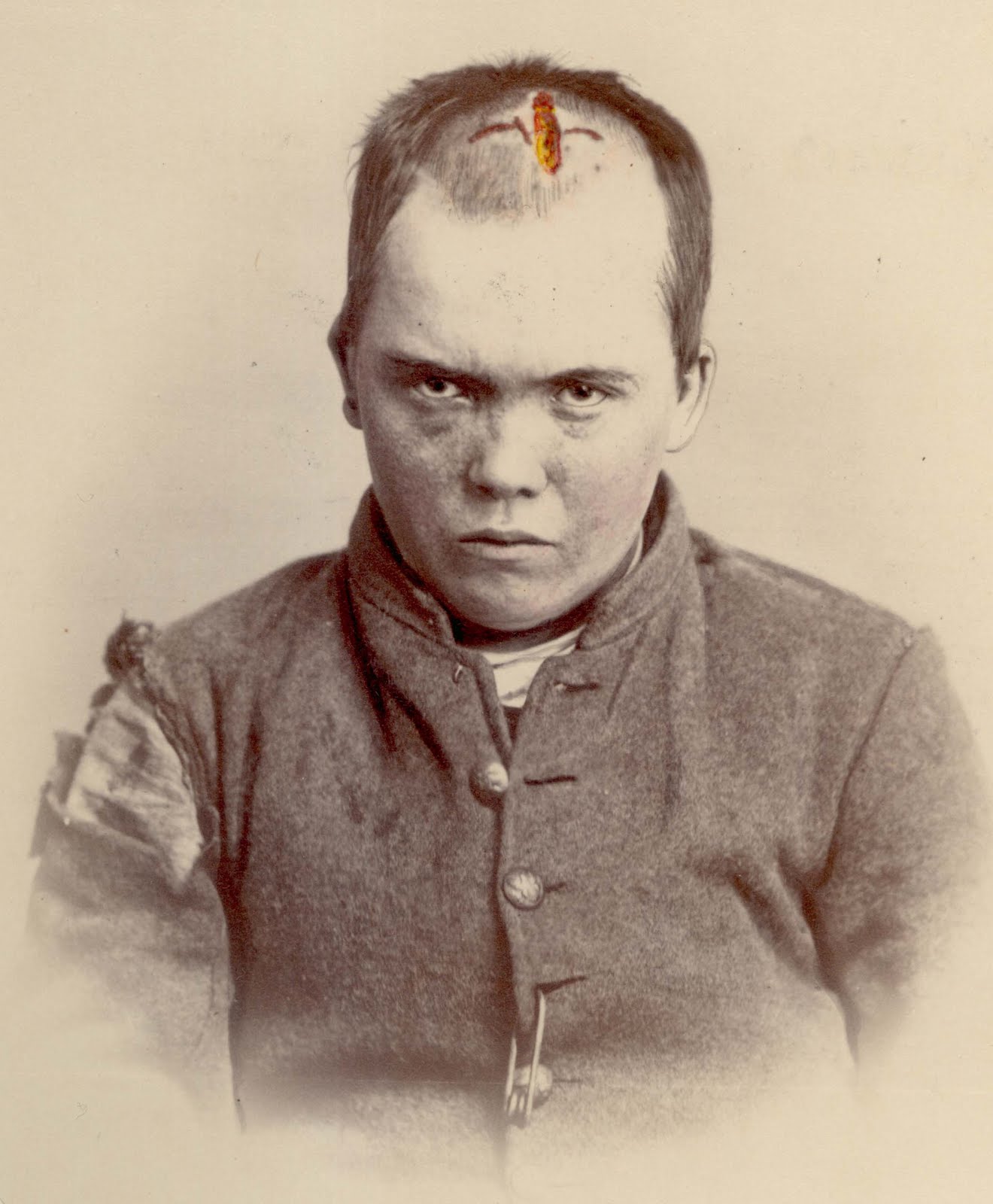
The days to come melted into a seemingly endless whir of battles, skirmishes, and periods of prolonged exposure to enemy sharpshooters and artillery. A little over two months in, Farris was shot in the chest and sent to Jackson Hospital in Richmond for treatment. He recovered and rejoined his unit on the front, only to find himself back at Jackson Hospital with a gunshot wound to the face in early March of 1865. Farris returned to his regiment in time for the Battle of Five Forks, where they left the trenches with Major General George E. Pickett’s Division to defend a vital crossroads southwest of Petersburg from the combined forces of Warren’s 5th Corps and Sheridan’s Cavalry Corps. Outnumbered and outflanked, the Confederates fought hard but were ultimately overwhelmed. In the maelstrom of battle, Farris was shot in the head and captured by Union soldiers.

Confederate prisoners after Five Forks

Lee’s Army of Northern Virginia was soon forced to abandon Petersburg and Richmond. While Grant’s forces cornered them near Appomattox Court House, a wounded James Farris was on his way to Lincoln General Hospital in Washington, D.C., where he was admitted with a fractured skull. Surgeon J.C. McKee reported removing depressed bone fragments from the wound on April 20. His wound proceeded to heal well.

By the time Farris posed for this portrait in his tattered shell jacket, the war was over. Though he served for only about eight months of a four year war, there is no doubt that the thrice-wounded teen was a veteran by this point. His body, like his clothes, is frayed and torn. But the look in his eyes says everything.

After signing the official Oath of Allegiance in June 1865, Farris was released from Lincoln Hospital. His descendants’ oral traditions hold that he bore an iron plate in his head for the rest of his life as a result of his third war wound. He returned to a life of farming and started a family in Steele Creek, North Carolina. He and his family later moved to Nacogdoches, Texas. By 1910 the lingering effects of his wound had caused him to go blind. James Farris died in 1914 and is buried in Christian Cemetery in Nacogdoches.

Thursday, July 21, 2011

Frederick Bentley, Survivor

Frederick A. Bentley
Co. A, 185th New York Infantry


Frederick Bentley was 12 years old when the first shots of the Civil War were fired. He didn't vote for the politicians who started it, and he probably didn't write chickenhawk newspaper articles or deliver loud speeches rallying his fellow Yankees to fight their brothers down South. If this farmer’s son from Lysander, New York had strong opinions about slavery or states rights or tariff policies they are lost to us now. What we do know is that Bentley was determined to serve his country, and enlisted in the army in August of 1864 when he was only 15. The muster rolls list his age as 18, but multiple census records reveal his actual year of birth was 1849. It was not all that uncommon for boys to lie about their age to enlist. For all we know it may not have been Bentley's first effort. The skinny, 5’ 3” teenager may not have made the most convincing 18-year-old, but recruiters were desperate to fill their quotas.


After a stint of infantry training, the newly-formed 185th New York Infantry was sent to the labyrinthian front lines of Petersburg, Virginia on September 27, 1864, where they were attached to the Army of the Potomac’s veteran 5th Corps. One of Bentley's comrades described their new home: "This is what we call the front, and a muddy, gloomy place it is." On March 29, 1865 at the Battle of Lewis’s Farm, the 185th found itself in an exposed, unsupported position and was raked with “a regular blizzard of bullets.” Over 200 men in the 185th were hit. Among them was young Bentley, shot through the chest by a Confederate minie ball. Civil War gunshot wounds tended to be particularly gruesome. The typical minie ball was a .58 caliber chunk of lead which usually flattened on impact, causing it to tear an even wider hole through a person’s body. Bentley was lucky the bullet at least exited. He was sent to a field hospital and eventually made his way to Harewood General Hospital in Washington, D.C., where he came under the care of Dr. Reed B. Bontecou. Bontecou had Bentley and many of his patients photographed to document their treatment and progress. This boy’s care was fairly minimal. In the days before penicillin and general anesthesia, there was not a whole lot that could be done for a wound like this. Bontecou’s note on the reverse of this photograph states simply, “He recovered under simple dressings, with very little stimulants, and no special diet.” After this miraculous recovery, Bentley returned home to New York, where he worked as a farmer and produce merchant until his death at the ripe old age of 71. He left behind at least one child, a daughter named Mary.

Though Bentley was extremely lucky to have survived his injury, this photograph gives us a faint glimpse into what he lived through. The physical pain, psychological trauma, and unimaginable grief and guilt over friends lost at his side reveals itself somewhere in those eyes. Above it all, though, Frederick Bentley looks to me like he is determined to live on. What nightmares accompanied his survival are lost to time. What remains is a lone image of a boy with a hole through his torso. He sits before the camera, his body and wounds laid bare.

I found the above image in this Flickr gallery of public domain photographs of wounded Civil War veterans from the National Museum of Health & Medicine. Though the photographs were taken for clinical reasons, they stand today as an incredible testimony to the wounded men and boys they portray, people exposed both physically and emotionally at the end of a long war. I hope to research a number of them and post what I find as I go. If anyone has more information, please feel free to share it.

Friday, January 21, 2011

A Drum Full of Bees


Let us begin with a drum full of bees. I hoped to have some accompanying audio for this, but apparently, the internet has some limitations. We'll have to leave some of this--including the soundtrack--to the imagination. Take a moment and picture an old army snare drum lying in the grass on a Pennsylvania farm. A bee emerges from a bullet hole in the drumhead. It flies off. Another one follows. Soon you realize the drum is filled with bees. A persistent buzzing resonates within. They've actually built their nest there. Or someone's prepared it for them. You see, this drum is the centerpiece of several divergent stories.

I first stumbled over the bee-filled drum while perusing the MOLLUS online photograph collection. There's a postcard with a photograph of it, which is useless to post, as the U.S. Army Heritage and Education Center apparently feels that the U.S. army's heritage is more educationey if viewed through the center of an enormous, opaque logo. The text of the card begins,

"'Kiss me before I die,' said the little drummer boy, to Mrs. Judge Fisher, of York, Pa., as he lay at the foot of Round Top, dying far away from home and his dear mother. She kissed his pale cheek, and tenderly held him in her arms, till his spirit had fled. His bereaved mother came several times in search of his body, but it could not be found until 1867, when it was sent to his home in Providence, R. I.

"His broken drum was found near him, by Farmer Jacob Weikert, who turned it into a bee-hive, which for sixteen years was used in this strange and significant employment."

The stirring account is accompanied by a poem by John Greenleaf Whittier:

"The Hive at Gettysburg"

In the old Hebrew myth the lion's frame
So terribly alive,
Bleached by the desert's sun and wind, became
The wandering wild bees' hive;
And he who lone and naked-handed tore
Those jaws of death apart.

In after time drew forth their honeyed store
To strengthen his strong heart.

Dead seemed the legend: but it only slept
To wake beneath our sky;
Just on the spot whence ravening Treason crept
Back to its lair to die,
Bleeding and torn from Freedom's mountain bounds,
A stained and shattered drum
Is now the hive where, on their flowery rounds,
The wild bees go and come.

Unchallenged by a ghostly sentinel,
They wander wide and far,
Along green hillsides, sown with shot and shell,
Through vales once choked with war.
The low reveille of their battle-drum
Disturbs no morning prayer;
With deeper peace in summer noons their hum
Fills all the drowsy air.

And Samson's riddle is our own to-day,
Of sweetness from the strong,
Of union, peace, and freedom plucked away
From the rent jaws of wrong.
From Treason's death we draw a purer life,
As, from the beast he slew,
A sweetness sweeter for his bitter strife
The old-time athlete drew!

I'll avoid drifting into a long-winded poetry analysis here, though I can't help but point out the flat political theme (just in case you didn't notice it). But that's beside the point. What is the point?

Well, the text on this postcard was written in 1883 by A.E. Tortat, an Episcopal reverend who used it to raise money for "a memorial of this young hero, or any of our country's dead, in the Historic Tower and Memorial Church, soon to be erected on this battlefield."

Tortat also penned this letter to the editor of The Churchman in 1883, describing the death of the drummer boy and declaring,

"I hold out his broken drum to all generous Church people, and indeed to all true souls, to cast in a few thousand dollars to begin at once this churchly monument....From the heights of Round Top I hold out our boy's drum for all to see. How many working bees shall hum their peaceful tune around it with this opening spring, and briog in their sweetest gifts of love and gratitude to God, and of kind remembrance of our beloved dead? Particulars about this monument of piety and patriotism may be had from your correspondent,
A. E. Tortat,
Rector of the church of " the Prince of Peace,"
Gettysburg, Adams county, Pa.

"PS.—We have various sizes of granite stones, finely cut, ready for engraving, costing in Philadelphia from $10 to $20. These we now offer, free of charge, to early applicants, charging only 30 cents per letter for inscribing, placing, and covering them. Also, polished stones at 50 cents per letter, mid cheaper stones for inside at 35 cents per letter."

Where is this all going, you ask? Well, actually, I'm as unsure now as when I started researching this. I wanted to get the bottom and there was no bottom to be found. Tortat never identified the boy or explained how he died. I was not entirely convinced he even existed at all. Yet I still believed in the beehive drum. That part seems too beautifully weird to have been invented by Whittier.

Enter Mrs. Judge Fisher, the supposed original source of the dying drummer boy story. According to Tortat, her account originally appeared in the Philadelphia Times. I couldn't find that article, but I did find one from an online copy of The Lakeside Press of Cleveland, NY, also dated 1883. She apparently went to Gettysburg immediately after the battle to help care for the wounded, a heroic task in and of itself. Her account seems familiar, yet strange and curious:

"I found him at the farthest extremity of the hospital, with a half dozen other hopeless cases. He was a lovely boy, scarcely more than a child, who had run away from his home in Providence, RI, to join the 'drum corps.' He was a brave boy and a great pet among the soldiers, who nursed him as tenderly as possible, but could poorly supply a mother's loving care. How he longed for one more look of her dear face and once again to hear her sweet words of love! He was so frail and slight it was a marvel how he could have endured the fatigue and privation so long. He was not disfigured by wounds, but constant marches, insufficient food and often sleepless nights had exhausted his strength and and he had not the vitality to resist the sharp attack of fever. He was perfectly conscious, but too weak to say much. I asked the poor child what I could do for him. 'Oh! I want my mother!' I sat down on the ground, and taking him in my arms tried to comfort him. He turned his face to me, saying 'I am so tired,' laid his head against me and appeared to sleep.

"The last rays of the sun touched the lovely features of the dying boy. The long-drawn shadows vanished in the gathering darkness. Silence, unbroken save the plaintive moan of some poor victim, succeeded the hum of the busy day. The pitying dews shed a balm upon his brow. Fainter and fainter grew the breath and more feeble the clasp of the little hand, when suddenly rousing he opened his eyes, glazed in death, and looking long and earnestly in my face, said 'Kiss me, lady, before I die!' Clinging still closer to the stranger who could faintly represent the fond mother's tenderness he so eagerly craved, he dropped his heavy lids and slept away his brief life as peacefully as a child goes to sleep in its mother's arms. I gently laid the lifeless form down on the hard earth and left him to a soldier's burial and a nameless grave. Poor fellow, what an atom he seemed to be in all that mass of wretched, dying humanity! Yet he was all the world to the heart of that mother, who wept and prayed for her darling's safe return to the distant home, that never again would echo his boyish step or ringing laugh."


The boy's identity is still a mystery to me. If he was from Rhode Island, it is likely he was a member of the 2nd Rhode Island Infantry, the only Rhode Island infantry unit at Gettysburg. Whether a coincidence or not, the centerpiece of their monument at Gettysburg is a drum.


Photo source: Gettysburg Daily

As for Tortat's church, the National Memorial Church of the Prince of Peace was completed in 1900 and still stands in Gettysburg as a house of worship and memorial to both sides of the Civil War. I could not find any reference to the story of the dying drummer boy and the role it played in the church's fundraising efforts. I was also unable to find anything to indicate where the beehive drum is today. If anyone can shed any light on these mysteries, I would greatly appreciate it. If anyone has a recording of bees inside a snare drum, please pass that along to me as well.
Tuesday, January 11, 2011

Arms and the Boy


I can't pinpoint the moment in my childhood when I first became obsessed with the Civil War. I do know that I was in middle school when I fervently began reading every Civil War book I could get my hands on. It was around this point that I first turned a page to find a photograph of a teenage Confederate soldier lying dead in the trenches. The caption indicated he was fourteen years old and had been killed by bayonet during the Union assault on Fort Mahone, part of the defenses of Petersburg, Virginia. Something changed. I don't know what happened; maybe this marked the first moment that the Civil War became real for me. Not really became, it was more like a flicker, a glimpse.

I've been struggling to understand my fixation with this image ever since. Fixation is the wrong word. Inability to escape? "Haunted" sounds cliched, but I can't think of a better word. The indescribable, familiar strangeness I've encountered studying history ironically drove me away from history as a discipline and into poetry. Fourteen years after I first encountered the dead Rebel, his likeness became the driving force behind my first book, Jerusalem Plank Road. By that time I had learned that the photographer, Thomas Roche, likely had no knowledge of the boy's age and conceivably even invented his cause of death. The only thing we can know with any amount of certainty is that this anonymous young man died early in his life, a week before Lee's surrender at Appomattox. He lost his youth and his future for a cause that was already lost. Then a photographer came along and immortalized his corpse. We choose what to take from this. A reminder of war's horror? A memorial to an act of bravery?

This was nothing new.


Consider Joseph Bara, the fourteen-year-old French soldier killed by Breton royalists in 1793. Robespierre, architect of the Terror, declared him a martyr to the Republic. His story grew into legend, his death the subject of various works of art, including a painting by Jacques-Louis David. Today, who can tell who Joseph Bara really was, what he thought, said, did? Or the pain and fear he may have felt in his last moments. Or how his mother and father took the news, or whether his comrades were haunted by what they saw and the memory of the friend they lost. Joseph Bara ceased to exist as a person. Yet he lives now in art. Is that even life? I understand why some people hate artists. It infuriates me that Roche lied to add a little more "color" to his photograph. It seems tragically ironic that the image of Joseph Bara's death was used as propaganda to inspire more to kill and to die. Yet wouldn't it be equally egregious if his death served as nothing but a warning that war is horrible? I grappled with this as the young Confederate came to "life" in some of the characters in my work. I didn't want him to be a symbol or a warning or a juxtaposition. I wanted him to be a boy. But the idealization of boyhood in art also troubled me. Boys aren't angels and they should never represent innocence alone. They are walking, running, dancing, killing, living paradoxes. Which makes their deaths all the more difficult to bear. Wilfred Owen was undoubtedly moved by the beauty of the boys he saw dying around him. I believe it made his compassion (and his outrage) all the more powerful.

Sometimes I think I just wanted the Rebel boy to breathe. I've considered writing him without the war. Like Bara without his uniform. Or his death, for that matter.


Mort de Bara by Jacques-Louis David


Pro Patria by Emile Edmond Peynot

Saturday, October 30, 2010

Lingering Faces


A private collector of U.S. Civil War-related photographs recently donated his collection of nearly 700 portraits of soldiers and sailors to the Library of Congress. The Liljenquist Family Collection is the largest collection of its kind the organization has received in years. The LOC has made most of them available online in its Prints and Photographs Reading Room and is planning to release the rest in the coming weeks. It's a haunting gallery of faces, many of which are quite young.


Thursday, October 28, 2010

Photographs of Life in Kentucky in the 1960s and 1970s by William Gedney


Photographer William Gedney recorded these moments in the lives of Kentucky mining families in 1964 and 1972. These images are from the Duke University Rare Book, Manuscript, and Special Collections Library, which provides the following description:

William Gedney made two trips to eastern Kentucky. In the summer of 1964, he traveled to the Blue Diamond Mining Camp in Leatherwood, Kentucky and stayed for awhile at the home of Boyd Couch, head of the local United Mine Workers Union. Then Gedney met Willie Cornett, who was recently laid off from the mines, his wife Vivian, and their twelve children. He soon moved in with the Cornett family, staying with them for eleven days. Twenty-two of the photographs from Gedney's 1964 visit to Kentucky were included in his one-man exhibition at the Museum of Modern Art in New York (December 1968 through March 1969). Gedney corresponded with the Cornetts over many years, and finally returned to Kentucky to visit and photograph the family again in 1972. In his notebooks Gedney writes about these lives he witnessed and photographed, the complicated relationships within such large families, the importance of the automobile. Gedney made notes about a creating a book dummy of the Kentucky work, but no completed dummy exists in the archive. With the exception of one image, the Kentucky photographs were never published during William Gedney's lifetime.


Thursday, June 10, 2010

Photo of Slave Children Found in NC Attic


Just stumbled across this incredible image, which, according to historians, was likely taken by photographer Timothy O'Sullivan in the early 1860s. Here's a link to the original AP story.