Showing posts with label photographs. Show all posts

Thursday, July 21, 2011

Frederick Bentley, Survivor

Frederick A. Bentley
Co. A, 185th New York Infantry


Frederick Bentley was 12 years old when the first shots of the Civil War were fired. He didn't vote for the politicians who started it, and he probably didn't write chickenhawk newspaper articles or deliver loud speeches rallying his fellow Yankees to fight their brothers down South. If this farmer’s son from Lysander, New York had strong opinions about slavery or states rights or tariff policies they are lost to us now. What we do know is that Bentley was determined to serve his country, and enlisted in the army in August of 1864 when he was only 15. The muster rolls list his age as 18, but multiple census records reveal his actual year of birth was 1849. It was not all that uncommon for boys to lie about their age to enlist. For all we know it may not have been Bentley's first effort. The skinny, 5’ 3” teenager may not have made the most convincing 18-year-old, but recruiters were desperate to fill their quotas.


After a stint of infantry training, the newly-formed 185th New York Infantry was sent to the labyrinthian front lines of Petersburg, Virginia on September 27, 1864, where they were attached to the Army of the Potomac’s veteran 5th Corps. One of Bentley's comrades described their new home: "This is what we call the front, and a muddy, gloomy place it is." On March 29, 1865 at the Battle of Lewis’s Farm, the 185th found itself in an exposed, unsupported position and was raked with “a regular blizzard of bullets.” Over 200 men in the 185th were hit. Among them was young Bentley, shot through the chest by a Confederate minie ball. Civil War gunshot wounds tended to be particularly gruesome. The typical minie ball was a .58 caliber chunk of lead which usually flattened on impact, causing it to tear an even wider hole through a person’s body. Bentley was lucky the bullet at least exited. He was sent to a field hospital and eventually made his way to Harewood General Hospital in Washington, D.C., where he came under the care of Dr. Reed B. Bontecou. Bontecou had Bentley and many of his patients photographed to document their treatment and progress. This boy’s care was fairly minimal. In the days before penicillin and general anesthesia, there was not a whole lot that could be done for a wound like this. Bontecou’s note on the reverse of this photograph states simply, “He recovered under simple dressings, with very little stimulants, and no special diet.” After this miraculous recovery, Bentley returned home to New York, where he worked as a farmer and produce merchant until his death at the ripe old age of 71. He left behind at least one child, a daughter named Mary.

Though Bentley was extremely lucky to have survived his injury, this photograph gives us a faint glimpse into what he lived through. The physical pain, psychological trauma, and unimaginable grief and guilt over friends lost at his side reveals itself somewhere in those eyes. Above it all, though, Frederick Bentley looks to me like he is determined to live on. What nightmares accompanied his survival are lost to time. What remains is a lone image of a boy with a hole through his torso. He sits before the camera, his body and wounds laid bare.

I found the above image in this Flickr gallery of public domain photographs of wounded Civil War veterans from the National Museum of Health & Medicine. Though the photographs were taken for clinical reasons, they stand today as an incredible testimony to the wounded men and boys they portray, people exposed both physically and emotionally at the end of a long war. I hope to research a number of them and post what I find as I go. If anyone has more information, please feel free to share it.

Sunday, February 27, 2011

The Frozen Past: Available in 3D

"Royal Gardens, Dresden, Germany." Undated.

Long before our recent 3D movie craze (before movies, for that matter) people enjoyed the simple magic of stereoscopic photography. Why look at a flat photo when you can leap right into a three-dimensional freeze frame? I picked up the photos in this post at a used book store few years ago and I've been meaning to post them for a while. They show images from around the world taken around the late nineteenth to early twentieth century. If you're into stereoscopy, I also highly recommend Clicksy Pics. The site's owner takes images like these seemingly still, dead photographs and breathes incredible life into them through animated gifs. I would not, however, recommend them to anyone suffering from epilepsy or susceptible to motion sickness. They're intense, though perhaps not quite Avatar intense.

"The Sad Roll Call after some of the British were cut off at Dordrecht (Dec. 30th), S.A." 2nd Boer War, South Africa, 1899. Published by Underwood & Underwood, 1900.

"Spanish prisoners freed by the Americans on the capture of Imus,--Las Pinas, Philippines." Spanish American War, 1898-1899. Published by Underwood & Underwood, 1899.

"Street Scene, Cairo, Egypt." Undated.

"The Stadium, Rome." Undated.

"Garden of Gethsemane. Palestine." Undated.

"Off for Porto Rico." Undated (Spanish American War?)

"A Public Well, Pekin, China." Undated.

Wednesday, February 16, 2011

Appalachian Trails


A few more photographs of eastern Kentucky in the 1960s and 70s by William Gedney. In his notes for these images, Gedney included a quote from Harry Caudill's Night Comes to the Cumberlands:

“Exhaustion is apparent on every hand—exhaustion of soil, exhaustion of men, exhaustion of hopes. Weariness and lethargy have settled closer everywhere. The nation, engulfed in its money-making and international politics, has paid no noticeable heed to its darkest area.”

Source: Duke University Rare Book, Manuscript, and Special Collections Library


Wednesday, January 19, 2011

A Battlefield Vulture


Source: New York State Historical Society.

A nigthmarish stereoview from Gettysburg, Pennsylvania: "A Battle-field Vulture, Godfor by name--one of those inhuman creatures who follow in the wake of armies, robbing the field of blankets, clothing, turning the pockets of the dead, &c." Who is this bizarre character?

Tuesday, January 11, 2011

Arms and the Boy


I can't pinpoint the moment in my childhood when I first became obsessed with the Civil War. I do know that I was in middle school when I fervently began reading every Civil War book I could get my hands on. It was around this point that I first turned a page to find a photograph of a teenage Confederate soldier lying dead in the trenches. The caption indicated he was fourteen years old and had been killed by bayonet during the Union assault on Fort Mahone, part of the defenses of Petersburg, Virginia. Something changed. I don't know what happened; maybe this marked the first moment that the Civil War became real for me. Not really became, it was more like a flicker, a glimpse.

I've been struggling to understand my fixation with this image ever since. Fixation is the wrong word. Inability to escape? "Haunted" sounds cliched, but I can't think of a better word. The indescribable, familiar strangeness I've encountered studying history ironically drove me away from history as a discipline and into poetry. Fourteen years after I first encountered the dead Rebel, his likeness became the driving force behind my first book, Jerusalem Plank Road. By that time I had learned that the photographer, Thomas Roche, likely had no knowledge of the boy's age and conceivably even invented his cause of death. The only thing we can know with any amount of certainty is that this anonymous young man died early in his life, a week before Lee's surrender at Appomattox. He lost his youth and his future for a cause that was already lost. Then a photographer came along and immortalized his corpse. We choose what to take from this. A reminder of war's horror? A memorial to an act of bravery?

This was nothing new.


Consider Joseph Bara, the fourteen-year-old French soldier killed by Breton royalists in 1793. Robespierre, architect of the Terror, declared him a martyr to the Republic. His story grew into legend, his death the subject of various works of art, including a painting by Jacques-Louis David. Today, who can tell who Joseph Bara really was, what he thought, said, did? Or the pain and fear he may have felt in his last moments. Or how his mother and father took the news, or whether his comrades were haunted by what they saw and the memory of the friend they lost. Joseph Bara ceased to exist as a person. Yet he lives now in art. Is that even life? I understand why some people hate artists. It infuriates me that Roche lied to add a little more "color" to his photograph. It seems tragically ironic that the image of Joseph Bara's death was used as propaganda to inspire more to kill and to die. Yet wouldn't it be equally egregious if his death served as nothing but a warning that war is horrible? I grappled with this as the young Confederate came to "life" in some of the characters in my work. I didn't want him to be a symbol or a warning or a juxtaposition. I wanted him to be a boy. But the idealization of boyhood in art also troubled me. Boys aren't angels and they should never represent innocence alone. They are walking, running, dancing, killing, living paradoxes. Which makes their deaths all the more difficult to bear. Wilfred Owen was undoubtedly moved by the beauty of the boys he saw dying around him. I believe it made his compassion (and his outrage) all the more powerful.

Sometimes I think I just wanted the Rebel boy to breathe. I've considered writing him without the war. Like Bara without his uniform. Or his death, for that matter.


Mort de Bara by Jacques-Louis David


Pro Patria by Emile Edmond Peynot

Sunday, December 19, 2010

Miners


MINERS
by WILFRED OWEN

There was a whispering in my hearth,
A sigh of the coal,
Grown wistful of a former earth
It might recall.

I listened for a tale of leaves
And smothered ferns,
Frond-forests, and the low sly lives
Before the fauns.

My fire might show steam-phantoms simmer
From Time's old cauldron,
Before the birds made nests in summer,
Or men had children.

But the coals were murmuring of their mine,
And moans down there
Of boys that slept wry sleep, and men
Writhing for air.

And I saw white bones in the cinder-shard,
Bones without number.
Many the muscled bodies charred,
And few remember.

I thought of all that worked dark pits
Of war, and died
Digging the rock where Death reputes
Peace lies indeed.

Comforted years will sit soft-chaired,
In rooms of amber;
The years will stretch their hands, well-cheered
By our life's ember;

The centuries will burn rich loads
With which we groaned,
Whose warmth shall lull their dreaming lids,
While songs are crooned;
But they will not dream of us poor lads,
Left in the ground.


Photograph by Lewis Hine


Photograph by Ben Shahn

Saturday, November 20, 2010

Far, Far Beneath


I've always been fascinated by sea monsters. The giant squid in particular is a creature that represents the intersection of myth and reality, where the tall tales of sailors proved based in truth. The image of a tentacled behemoth--a kraken--has fascinated artists and writers for millennia, but not until recent times have scientists finally been able to begin to illuminate this entity previously consigned the deepest depths of fantasy, science fiction and cryptozoological speculation. Even as we begin to understand the great beast as a living, breathing creature, it still maintains its allure as a manifestation of the darkest reaches of the human psyche.


Illustration source: Somefield.


"The Kraken" by Alfred, Lord Tennyson

Below the thunders of the upper deep,
Far, far beneath in the abysmal sea,
His ancient, dreamless, uninvaded sleep
The Kraken sleepeth: faintest sunlights flee
About his shadowy sides; above him swell
Huge sponges of millennial growth and height;
And far away into the sickly light,
From many a wondrous grot and secret cell
Unnumbered and enormous polypi
Winnow with giant arms the slumbering green.
There hath he lain for ages, and will lie
Battening upon huge sea worms in his sleep,
Until the latter fire shall heat the deep;
Then once by man and angels to be seen,
In roaring he shall rise and on the surface die.


Sunday, November 14, 2010

Soldier as Child


A parent's memorial to a teenage son killed in the last days of the U.S. Civil War. The childhood tintype of a soldier named Carl is accompanied by a lock of his hair and a note which quotes from Shakespeare's Hamlet:

"My beloved son Carl taken from me on April 1, 1865, at age 18, killed at Dinwiddie. Flights of angels sing thee to thy rest."

Source: Liljenquist Family Collection, Library of Congress.

Wednesday, November 10, 2010

With an Identity Disc


(Note: "Identity disc" refers to the British equivalent of the U.S. "dog tag" worn to identify a soldier in the case of his death)

WITH AN IDENTITY DISC
by WILFRED OWEN

If ever I had dreamed of my dead name
High in the heart of London, unsurpassed
By Time for ever, and the Fugitive, Fame,
There taking a long sanctuary at last,

I better that; and recollect with shame
How once I longed to hide it from life's heats
Under those holy cypresses, the same
That keep in shade the quiet place of Keats.

Now, rather, thank I God there is no risk
Of gravers scoring it with florid screed,
But let my death be memoried on this disc.
Wear it, sweet friend. Inscribe no date nor deed.
But let thy heart-beat kiss it night and day,
Until the name grow vague and wear away.

Tuesday, November 9, 2010

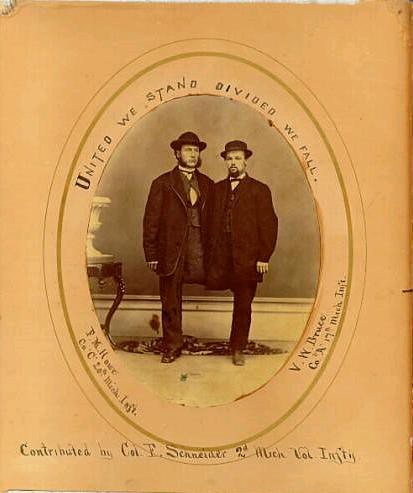
United We Stand


"United We Stand. Divided We Fall."

Portrait of Civil War veterans Frank M. Howe and Velorus W. Bruce, 1865-1866. Howe was a member of the 20th Michigan Infantry whose leg was amputated due a wound he received in the Petersburg Campaign. Bruce was in the 17th Michigan and wounded at Campbell's Station, Tennessee. Source: Archives of Michigan.

Monday, November 1, 2010

A Smoke and a Wiggle with Mark Twain

Photobucket

A colorized "wiggle animation" from Clicksy Pics. Clicksy creates these images by layering the two sides of a stereo card into an animated gif. They've recently begun adding color to the images, and in this portrait of Mark Twain, they've even added blinking eyes and rising smoke. The resulting looped animation is surreal. Is Twain shaking his head in disapproval, is he dancing, or do I just keep switching eyes?

Saturday, October 30, 2010

Lingering Faces


A private collector of U.S. Civil War-related photographs recently donated his collection of nearly 700 portraits of soldiers and sailors to the Library of Congress. The Liljenquist Family Collection is the largest collection of its kind the organization has received in years. The LOC has made most of them available online in its Prints and Photographs Reading Room and is planning to release the rest in the coming weeks. It's a haunting gallery of faces, many of which are quite young.