Showing posts with label virginia. Show all posts

Wednesday, August 10, 2011

Jacob Immell

Jacob Immell
Pvt., Co. L, 21st Pennsylvania Cavalry


I have not been able to find out much about the life of Jacob Immell. No descendents chronicled his life and career. No pension records exist, nor do any census reports trace the growth of his family in the postwar years. Unlike Fred Bentley and James Farris, Immell did not survive to return to his home in Greene Township, Pennsylvania. A farm boy, he may have aspired to one day own land of his own, work out in the sun, and nurture his crops to grow tall year after year. He never had that opportunity or the chance to love, marry, and have children. If he planned on going to college, traveling the country or even the world, or simply watching the sunset from his own front porch, it was never to be. Whoever Immell would have been and whatever contributions he would have made died with him on June 15, 1865, over two months after Lee’s surrender at Appomattox, from a leg wound suffered in the Battle of Amelia Springs on April 5. He was about twenty years old. Enlisting at the age of eighteen in August, 1863, Immell had already survived numerous engagements from Cold Harbor through the Petersburg Campaign.

Uncovering the descendents of Bentley and Farris really brought home for me the enduring tragedy of those who did not survive the war. There is not only the immeasurable loss of a man taken before his time, but each death in a sense reverberates through the generations, as it represents the possibility of countless others who will never be at all. His children, grandchildren, and so forth may have included great teachers, scientists, and civil rights pioneers, but whether great or small they would undoubtedly have been friends, cousins, lovers, spouses, and parents. Though no one who loved Jacob Immell is alive today to suffer his absence, his death is, like those of all our war dead, an abiding scar upon the heart of his nation.

A description of Immell's wound and death from gangrene by Surgeon Reed B. Bontecou. This and the above photograph of Immell are from the National Museum of Health and Medicine's gallery on Flickr.

One thing I did discover about Immell is he was buried on the estate of General Robert E. Lee’s wife’s family, on land which the U.S. government confiscated in 1864 for the establishment of a burial ground for fallen Union soldiers. His tombstone can still be viewed there at his final resting place, Arlington National Cemetery.

Immell's headstone from FindAGrave.com

Thursday, July 21, 2011

Frederick Bentley, Survivor

Frederick A. Bentley
Co. A, 185th New York Infantry


Frederick Bentley was 12 years old when the first shots of the Civil War were fired. He didn't vote for the politicians who started it, and he probably didn't write chickenhawk newspaper articles or deliver loud speeches rallying his fellow Yankees to fight their brothers down South. If this farmer’s son from Lysander, New York had strong opinions about slavery or states rights or tariff policies they are lost to us now. What we do know is that Bentley was determined to serve his country, and enlisted in the army in August of 1864 when he was only 15. The muster rolls list his age as 18, but multiple census records reveal his actual year of birth was 1849. It was not all that uncommon for boys to lie about their age to enlist. For all we know it may not have been Bentley's first effort. The skinny, 5’ 3” teenager may not have made the most convincing 18-year-old, but recruiters were desperate to fill their quotas.


After a stint of infantry training, the newly-formed 185th New York Infantry was sent to the labyrinthian front lines of Petersburg, Virginia on September 27, 1864, where they were attached to the Army of the Potomac’s veteran 5th Corps. One of Bentley's comrades described their new home: "This is what we call the front, and a muddy, gloomy place it is." On March 29, 1865 at the Battle of Lewis’s Farm, the 185th found itself in an exposed, unsupported position and was raked with “a regular blizzard of bullets.” Over 200 men in the 185th were hit. Among them was young Bentley, shot through the chest by a Confederate minie ball. Civil War gunshot wounds tended to be particularly gruesome. The typical minie ball was a .58 caliber chunk of lead which usually flattened on impact, causing it to tear an even wider hole through a person’s body. Bentley was lucky the bullet at least exited. He was sent to a field hospital and eventually made his way to Harewood General Hospital in Washington, D.C., where he came under the care of Dr. Reed B. Bontecou. Bontecou had Bentley and many of his patients photographed to document their treatment and progress. This boy’s care was fairly minimal. In the days before penicillin and general anesthesia, there was not a whole lot that could be done for a wound like this. Bontecou’s note on the reverse of this photograph states simply, “He recovered under simple dressings, with very little stimulants, and no special diet.” After this miraculous recovery, Bentley returned home to New York, where he worked as a farmer and produce merchant until his death at the ripe old age of 71. He left behind at least one child, a daughter named Mary.

Though Bentley was extremely lucky to have survived his injury, this photograph gives us a faint glimpse into what he lived through. The physical pain, psychological trauma, and unimaginable grief and guilt over friends lost at his side reveals itself somewhere in those eyes. Above it all, though, Frederick Bentley looks to me like he is determined to live on. What nightmares accompanied his survival are lost to time. What remains is a lone image of a boy with a hole through his torso. He sits before the camera, his body and wounds laid bare.

I found the above image in this Flickr gallery of public domain photographs of wounded Civil War veterans from the National Museum of Health & Medicine. Though the photographs were taken for clinical reasons, they stand today as an incredible testimony to the wounded men and boys they portray, people exposed both physically and emotionally at the end of a long war. I hope to research a number of them and post what I find as I go. If anyone has more information, please feel free to share it.

Tuesday, November 9, 2010

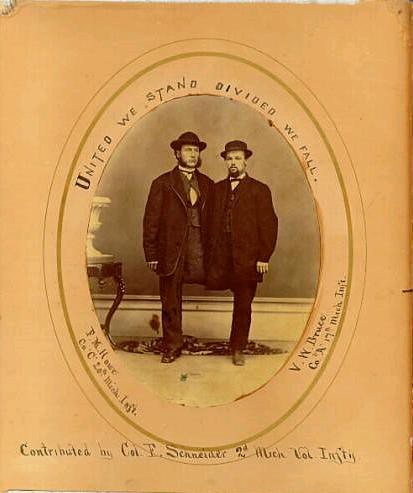
United We Stand


"United We Stand. Divided We Fall."

Portrait of Civil War veterans Frank M. Howe and Velorus W. Bruce, 1865-1866. Howe was a member of the 20th Michigan Infantry whose leg was amputated due a wound he received in the Petersburg Campaign. Bruce was in the 17th Michigan and wounded at Campbell's Station, Tennessee. Source: Archives of Michigan.

Thursday, May 27, 2010

And Waves Wash the Imprints Off the Sand


Richmond, Virginia, April 1865. Source: Library of Congress.


Hobart Smith - "Wabash Blues"